
The following tables show information on the
density (hardness) and stability of various wood species produced by  .
Once you have selected a species of wood for your project, your choice
is not limited to these 2 elements. The wood’s colour and appearance
remain to be considered. It is important to understand the physical properties
of different species to make the best choice.
.
Once you have selected a species of wood for your project, your choice
is not limited to these 2 elements. The wood’s colour and appearance
remain to be considered. It is important to understand the physical properties
of different species to make the best choice.
THE DENSITY (HARDNESS) OF WOOD SPECIES
The concept of hardness is, in fact, the wood’s reaction of dents
and scratches. The hardwood species produced by
are among the most popular and have relatively good degrees of hardness.
A hard (non-compressible) wood generally has a greater propensity to splitting,
but on the other hand, it offers greater resistance to dents.
The numbers below represent the force needed to sink a 0.444" (1.13
cm) steel slug half-way through the piece of wood.
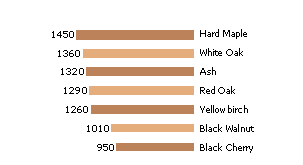
(Order: Hardest to softest species)
It is important to recognise that the force (or weight) required to dent a hardwood floor is always relative to the surface on which the force (or weight) is applied. For example, a person weighing 120 lbs (54 kg) wearing ¼” (6 mm) heels will exert enough force onto the wood to damage it noticeably. On the other hand, an elephant weighing 4000 lbs (1800 kg) walking on the hardwood floor will cause no damage because its weight is distributed evenly among its 4 huge feet. A ballpoint pen falling from a 36” height (less than 1 m) onto its point will dent the hardwood. However, if that same pen falls flat on its side, it will leave no damage.
To preserve the beauty of your hardwood floor, certain precautions must be taken. Spike heeled-shoes, chair legs, heavy furniture, even your pets can damage it. Refer to the maintenance guide and warranty for more information.
SPECIES STABILITY
Wood stability is determined mainly by the density of its rings. Generally speaking, the tighter these are, the more stable the wood, and the opposite is also true: the greater the spaces between the rings, the greater the tendency of the wood to dilate (expand) and contract with the moisture content of the area where it’s kept.
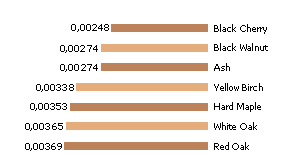
(Order: Most stable to least stable species)
Black Cherry is the most stable among the species produced by
.
When the moisture content of the room (the relative humidity) is above normal
(40 - 45%), strips have a tendency to expand as the moisture content
in the wood increases. On the other hand, when relative humidity is lower
than recommended, the strips will tend to contract, creating slight spaces
between them. This phenomenon is normal and natural.It’s important to note that the wider the strips, the more noticeable this phenomenon of expansion and contraction. The reason is obvious: wider strips require fewer rows to cover the same area. Expansion variations due to fluctuating relative humidity (especially in the case of strip contraction in dry weather) will be spread out on a smaller number of strips, consequently creating larger gaps between strips.
Relative humidity is directly related to the moisture content of the
wood. The following table demonstrates this relationship.
Relative humidity |
Wood moisture content |
20% |
4,5% |
40% |
7,7% |
65% |
12,0% |
For example, if the relative humidity of a room with a red oak floor with 5” (127 mm) strips changes from 40% to 65%, the wood’s moisture content will rise from 7.7% to 12% and strip expansion will be:
Difference in wood moisture content X species coefficient X strip width
(12.0% - 7.7%) X 0.00369 X 5" = 0.0793" (2.02 mm) per strip
For a surface area of 10 feet (3.04 m) wide, this means a total expansion of 1 7/8” (4.8 cm). It must also be noted that strip expansion and contraction is mainly in terms of strip width. Also expansion rates can vary from one strip to another depending on the direction of the growth rings on the strips. When expansion and contraction happens, it’s easy to solve the problem; just control the relative humidity in the room. After a while the wood will return to its original shape.
To preserve the beauty and stability of your hardwood floor, certain
precautions may be taken. Refer to the maintenance guide and warranty
for more information.